
Built by a founder who nearly dropped out of university, Remilo helps universities make course materials accessible at scale, starting with the STEM content other tools can’t handle.
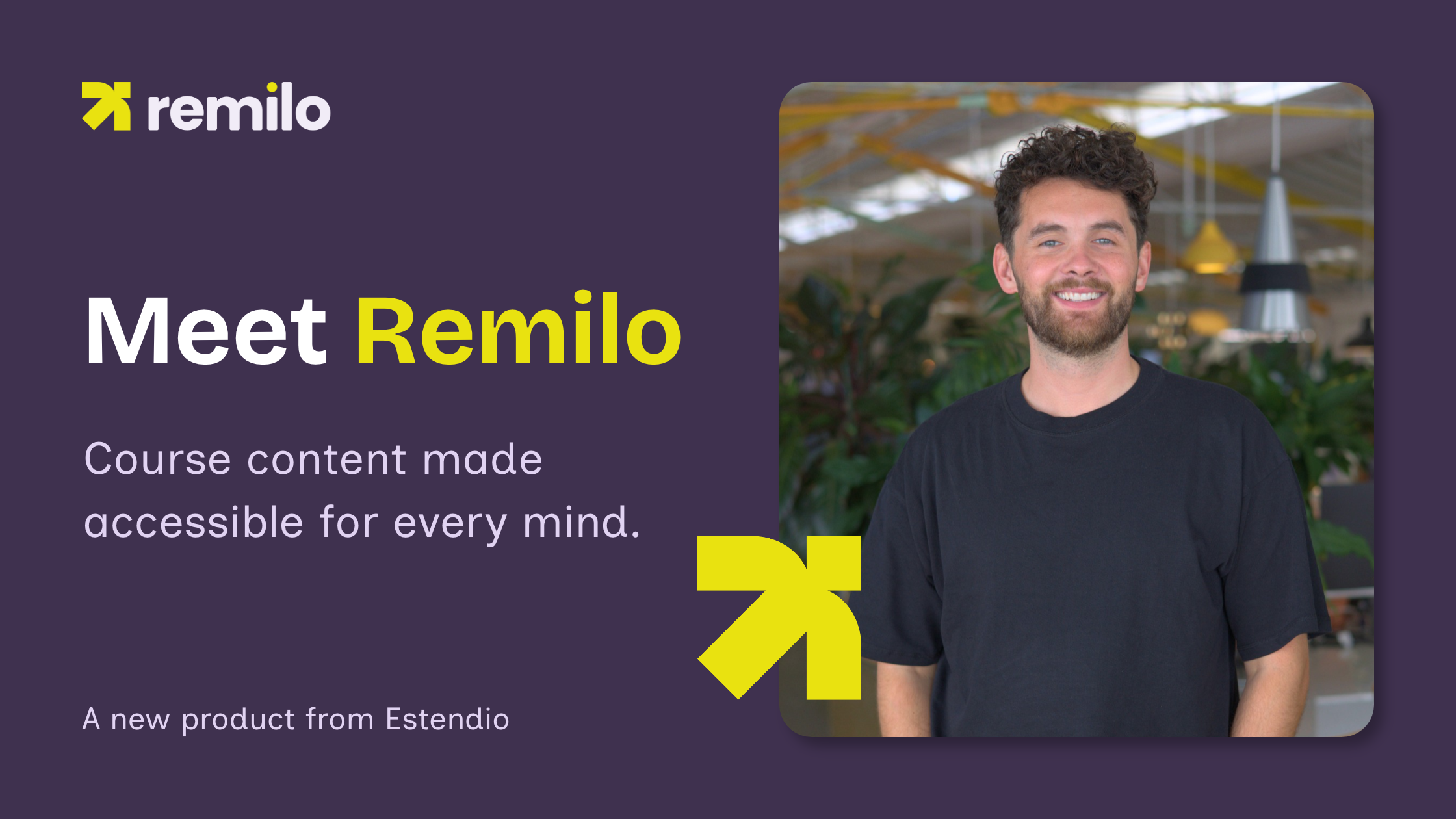
Denver, Colorado and Glasgow, Scotland, 17 November 2026. Estendio, the accessibility technology company behind Tailo and Present Pal, today launched Remilo, a platform that helps universities make their course content accessible at institutional scale.
Estendio’s existing tools work directly with students, helping them read, research and present in ways that suit how they learn. Remilo is different. It’s built for the institution: it works directly inside the university’s learning management system (LMS), finds accessibility issues across course materials and fixes them at source, so every student receives accessible content from the start rather than having to request it or convert it themselves.
Remilo is being introduced this week at Accessing Higher Ground, the accessible media, web and technology conference hosted by AHEAD in Denver.
It starts with a student
In 2014, Estendio founder Chris Hughes was a university student with dyslexia and ADHD.
“I struggled so much with presentations that I nearly dropped out,” says Chris. “I looked everywhere for a solution, but I couldn’t find one, so I created one for myself. That became Estendio.”

Where it began: Chris with Present Pal, Estendio’s first product.
That first tool became Present Pal. Today, Estendio’s tools for students, including Tailo, are used at nearly every university campus across the UK, and the company’s mission is to make all content accessible by 2030.
“Accessibility isn’t a new challenge for us,” Chris says. “It’s why we exist.”
From one student at a time to whole institutions
Working with students showed the Estendio team where the real problem starts. Students using Tailo were uploading inaccessible course readings to make them usable. It helped, but it meant students were still the ones doing the work, one document at a time.
Remilo tackles the problem upstream. Instead of supporting each student after they receive an inaccessible document, it helps the institution fix the document before any student sees it.
For students
Tailo and Present Pal
Tools individual students use to read, research and present in ways that work for them.
For institutions
Remilo
A platform for accessibility and instructional design teams to make course content accessible at source, across the whole institution.
Behind every inaccessible document is a person
Higher education is at a turning point. With the ADA Title II deadline for digital accessibility set for April 2027, US institutions are under pressure to make large volumes of course content accessible.
Most of the conversation is about deadlines and compliance, but Chris argues the real stakes are personal.
“Behind every inaccessible document is a student who can’t fully participate in their education. That’s the problem we’re here to solve.”
The scale of the problem is enormous. Universities hold millions of documents, many containing complex equations, diagrams and videos. The teams responsible for them are often just a few accessibility specialists and instructional designers who are already stretched to their limits. Many existing tools can flag problems but leave the fixing to people, and they often struggle with STEM material such as handwritten equations, complex charts and lab reports.
Meet Remilo
Remilo is built to fix content, not just find problems. It works directly inside the LMS, scans course content for accessibility issues and remediates them at institutional scale, so accessibility teams can clear backlogs and faculty can fix their own materials without leaving the LMS.
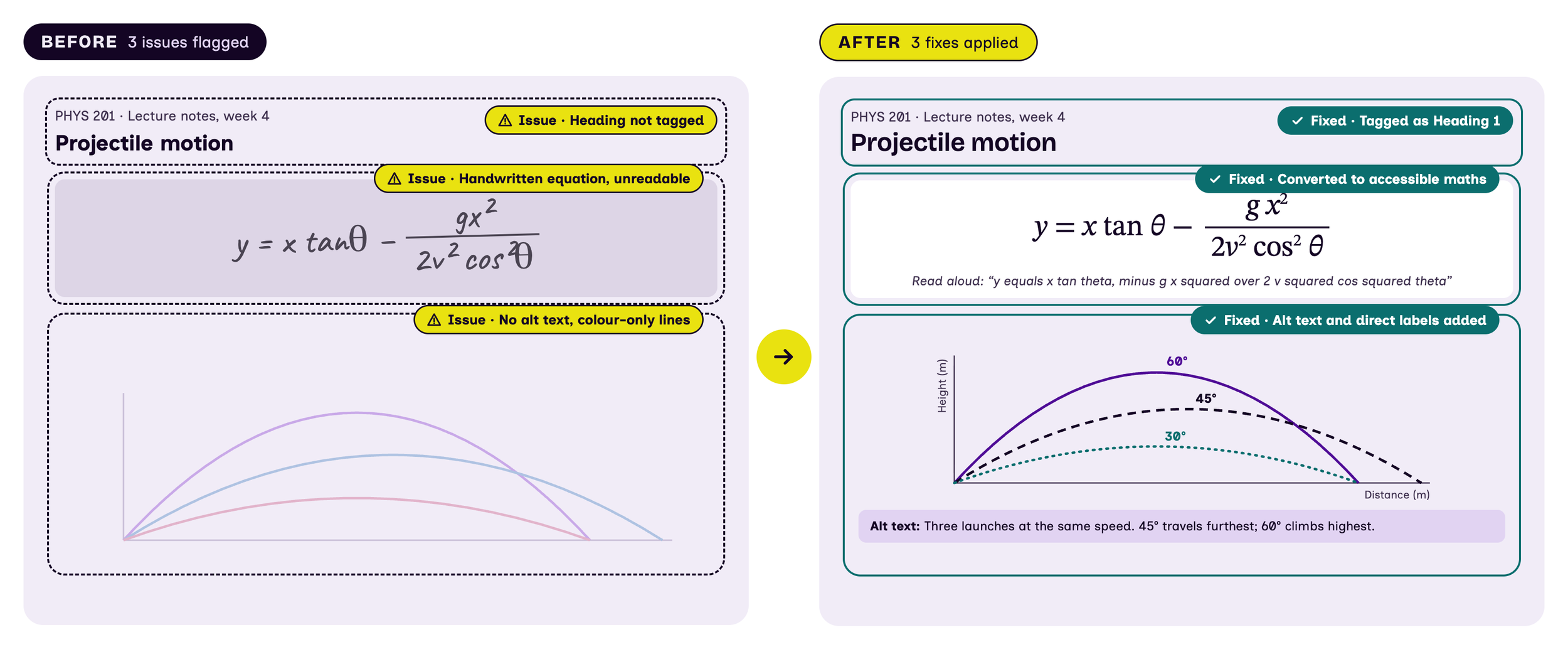
A handwritten calculus document in Remilo, before and after remediation.
-
Fixes, not just flags. Remilo uses AI-powered remediation to resolve issues across whole courses, with one click, instead of producing another list of errors for someone to work through.
-
It works inside your LMS. Accessibility teams and faculty fix content where they already work every day, with no exporting or switching between tools.
-
It’s built for STEM. Remilo detects handwritten equations and transforms them into accessible formats, and its equation and chart editors work directly in the document view.
“We’re building technology to tackle some of accessibility’s hardest challenges,” says Chris. “That means transforming complex course material into accessible formats at an institutional scale, and not just finding the problems but fixing them.”
Built with the people who know the problem best
Remilo has been shaped by conversations with accessibility leads, instructional designers and faculty, the people who manage course content every day.
“After hearing from faculty and accessibility teams about how challenging and time-intensive it is to make documents accessible, we designed Remilo so there’s no need to leave the LMS and issues can be fixed with the click of a button. So far, feedback has been really positive, particularly on challenging STEM documents, which were the worst offenders. We’re excited to be working with some early adopters to continue shaping the product.”
The difference Remilo aims to make goes beyond compliance. As one accessibility leader told the Estendio team during early research, there’s access, and then there’s meaningful access. Remilo is built for the second.
Meet the team at AHG
Chris will speak at Accessing Higher Ground in a session called Lived Experience, Built Solutions, where he’ll share more of his story. The Estendio team will also be in the exhibit hall to demo Remilo, so come and say hello.
Chris’s session
Wednesday 18 November, 2pm MT
Lived Experience, Built Solutions
Exhibit hall
Table 24
Live Remilo demos all week
For universities and colleges
Fix it once.
Every student benefits.
Remilo finds and fixes accessibility issues in course content, right inside your LMS and at institutional scale, including the STEM material other tools can’t handle.
Months until the ADA Title II deadline
About Estendio
Estendio is a Glasgow-based accessibility technology company founded by Chris Hughes. Its tools for students, including Tailo and Present Pal, are used at nearly every university campus across the UK, and its first institutional product, Remilo, helps universities make course content accessible at scale. Estendio’s mission is a world where all content is accessible by 2030.
About Remilo
Remilo is an accessibility remediation platform for higher education institutions. It works directly inside an institution’s learning management system, finds and fixes accessibility issues in course content at institutional scale, and specialises in complex STEM material. Learn more at remiloapp.com.
